stillpoint

musings from Canadian author Cheryl Cooke Harrington ... home of The Write Spot

Thursday, November 10, 2016

remembering...


As always in the lead-up to Remembrance Day, I find myself thinking about my Dad, about the brave and honourable man he was, about the sacrifices he made for Canada, and about the wonderful, loving father he became. I think, too, about my Mom, the separation and uncertainty she endured during the six long years of World War II, and the overwhelming relief and joy she must have felt when her soldier, the love of her life, came marching home.

At the end of 1939, Dad enlisted in the Irish Regiment of Canada. He trained at Camp Borden, north of Toronto, and was based there until his deployment to Europe in 1941. Here's a photo of Mom and Dad, taken on his last leave. Mom found his midnight pass with its poignant and hopeful "keep this for me" note, tucked into her pocket after they'd kissed goodbye.


Dad and The Irish served briefly as the Queen's Guard at Sandringham. Here he is, standing proudly at attention with the Queen and Princesses Elizabeth and Anne. If you follow stillpoint, you'll have seen this image before. It's one of my favourites. This was a proud moment for Dad, a bright spot in the darkness of war.


Dad's platoon was shelled while on a midnight reconnaissance mission in Italy and he was wounded by shrapnel. As a teenager, twenty years later, I began having nightmares about darkness, explosions, and pain. Only then did Dad share the story of that terrifying night. I can't explain it but we both believed I was somehow reliving his experience in that field in Italy. I described things he'd never shared, not even with Mom. After we talked it out, my nightmares stopped. I'd like to believe Dad's did, too. We never spoke of it again.

After a short stay in a field hospital, Dad returned to active duty and served in Italy until the end of the war. It was a snowy, mid-winter day in Toronto when the Irish Regiment came home. This was my grandparents' house on Norway Avenue, all decked out with flags and bunting. (You can't see it in the picture  and no other photo exists  but Dad was sporting a carefully cultivated strawberry blond handlebar mustache. Mom told him it would have to go if he ever wanted another kiss. Dad claims he'd never shaved so fast in his life!) 


Thank you Dad, for all you did and for all you were. And thanks to all the brave men and women who have served and sacrificed for Canada and for peace. 

On November 11th, remember them.


Permalink: remembering...


stillpoint is the blog of Canadian author Cheryl Cooke Harrington


Labels: , , , , , ,

Wednesday, October 05, 2016

The Write Spot: Susan Elia MacNeal


I'm absolutely thrilled to have New York Times and USA Today bestselling author Susan Elia MacNeal as my guest for this special edition of The Write Spot. She's sharing a few of her favourite writing spots and introducing The Queen's Accomplice, the new book in her Maggie Hope mystery series, released October 4th.

Thanks to Penguin Random House and NetGalley, I had the opportunity to read an advance copy of The Queen's Accomplice and savoured every minute of it. As with all the Maggie Hope books, The Queen's Accomplice is first and foremost a terrific story – thought provoking, involving, meticulously researched, and elegantly told. (Read my five-star review, here.) I'm already feeling impatient for the next instalment and, with the news that Daisy Ridley (Star Wars: The Force Awakens) has bought the rights to the entire Maggie Hope series, I'm hoping we'll soon see Maggie on the big screen, too. How exciting!

A bit about the author: Susan Elia MacNeal lives in the Park Slope area of Brooklyn with her husband and young son. When asked about her background, she says, "I grew up in Buffalo, New York (Blizzards! Chicken wings! Sabres!) and went to Nardin Academy, which is an all-girls Catholic school. I then went to Wellesley College, where I majored in English, and cross-registered for classes at MIT. Did the Radcliff Publishing Course at Harvard (a six-week summer book and magazine intensive), and was able to get a coveted paid internship at Random House. From there, I worked my way up the editorial ladder at Viking/Penguin and McGraw-Hill, until I landed my dream publishing job, as an associate editor and staff writer at Dance Magazine. It's been a wonderful "full circle" for me that the Maggie Hope series is being published by Random House, where I first interned."

Welcome, Susan. Tell us what makes 'The Write Spot' for you.

I live in New York City and so, once my son was born eleven years ago, I didn’t have an office/spare bedroom anymore. So, typically, I’m at home and writing at my desk in the dining room – or, more likely, slouched on a sofa or even in bed (hey, at least there’s a door for the bedroom, which is key to privacy and quiet!). I've tried several different New York City writing spaces (The Writers Room, Paragraph) and while they’ve been lovely, there's nothing that beats writing at home in your pjs. So I continue to couch write, usually with five-year-old tabby cat, Lola, nearby. Other options are the library, various local cafes (I'm partial to one called Cocoa Bar), and the apartments of friends who are out-of-town. And I've written on trains, planes, and automobiles, literally!


Here's my desk – the pale pink juxtaposes nicely with the chart I made of The Queen's Accomplice's Blackout Beast's murder victims and Jack the Ripper's victims, right? The postcard is of the puppet show Punch and Judy, an image I used throughout the novel.


Here a stack of books on my desk – research for the sixth book in the series. I really use my desk more for stashing things than writing.


Lola on the couch with me, as I try to edit. "Why don't you pet me, instead? Look, I'll make it easy by sitting on your manuscript!"


Lola again. Everyone's a book critic.


This is the ceiling of the gorgeous public library where I work sometimes.


Here's the view of Manhattan from a friend's penthouse balcony. We take care of their cats and rabbits while they're at their country house, so sometimes I'll work up there.


Working on a train. Love the train. I work on trains, planes, and automobiles.Trains are the best, though.


So many inspiring writing spots! I love that Manhattan view. Other than your computer or laptop, what's the one thing you couldn't be without in your Write Spot?

Coffee. A nice mug of coffee. Or at least water. That's really about it! I'm pretty low-maintenance.

What are you working on now?

I'm writing the sixth book in the Maggie Hope series, The Paris Spy (August 2017).


Can't wait! Where can readers find out more about you and your books?

My web site is susaneliamacneal.com and I'm on social media at the following sites. Come say hello!

Twitter: @SusanMacNeal

I also blog with six other mystery writers on Jungle Red Writers, which has been described as "The View, with bodies." It's a great place for mystery and thriller fans.

Thanks so much for visiting The Write Spot, Susan, it's been a real pleasure!

The Queen's Accomplice by Susan Elia MacNeal is available now from your favourite bookseller.

Spy and code-breaker extraordinaire Maggie Hope returns to war-weary London, where she is thrust into the dangerous hunt for a monster, as the New York Times bestselling mystery series for fans of Jacqueline Winspear, Charles Todd, and Anne Perry continues.
 
England, 1942. The Nazis' relentless Blitz may have paused, but London's nightly blackouts continue. Now, under the cover of darkness, a madman is brutally killing and mutilating young women in eerie and exact re-creations of Jack the Ripper's crimes. What's more, he's targeting women who are reporting for duty to be Winston Churchill's spies and saboteurs abroad. The officers at MI-5 quickly realize they need the help of special agent Maggie Hope to find the killer dubbed "the Blackout Beast." A trap is set. But once the murderer has his sights on Maggie, not even Buckingham Palace can protect the resourceful spy from her fate.
 
Buy the book from your independent bookseller or from...


Subscribe to stillpoint – You'll receive email notification when a new blog is posted, no more than once a week and absolutely no spam, I promise!


About The Write Spot:
I've always been fascinated by what goes on behind the scenes. Whether it's backstage photos from my favourite play, a peek into the kitchen where a chef is working her culinary magic, or simply a glimpse through an uncurtained window into a stranger's private world, there's an undeniable thrill of discovery, a sense of secrets shared. It's no surprise, then, that I'm immensely curious about where other writers do their work.  I first blogged about it in this post about my own 'write spot' and so enjoyed the comments, I was inspired to launch a regular feature here at stillpoint. Join me as I discover the many and varied places where writers write.


stillpoint is the blog of Canadian author Cheryl Cooke Harrington.


Labels: , , , , , , , , , ,

Wednesday, September 07, 2016

school dazed...


On a scale of one to ten, where ten meant "favourite thing ever" and one meant "bane of my existence", school consistently ranked a lowly one or two in my books. Sometimes it managed to slide right on down into negative numbers. Mine was a passionate aversion. So intense that, even now, decades after leaving the hallowed halls forever, I'm still haunted by the icy fingers of anxiety at this time of year.


Suddenly I'm five years old again, horrified by the fading summer, by the looming menace of the great unknown, by… The First Day of School. The situation required a firm stand. "No school for me," I told Mom and Dad. "I don't want to." It may have been more like foot stamping than firm standing.

My parents, bless them, tried gentle encouragement and even a bit of bribery. They said I'd make lots of new friends. ("Don't want new friends. I'm shy."). They hinted at wonderful new toys and games to play. ("I like my toys.") They promised I'd love my teacher. (I won't! She's mean!) They offered new shoes and a pretty new outfit. (Tempting, but… "I won't go and you can't make me!")

I can only imagine how exasperated they must have been when, after weeks of cajoling, they finally resorted to, "Enough! You have to go to school. It's the law." 

I consulted the neighbour kids, Linda and Billy. Older than me and wise in the ways of school and the law, they filled my head with whispered tales of truant officers and reform school – a dismal place with bars on the windows and stale bread with tepid water for dinner.

And so, on a fateful September Tuesday, I marched (not so) bravely up the street, wearing my crisp white blouse, swishy plaid skirt, and shiny new shoes. Mom pep-talked me all the way to school, holding tight to my hand in case I might bolt for home. I didn't want to cry, but by the time we reached the school yard, my face was wet with tears and each breath came in a tight sob. 

Life as I knew it was over.


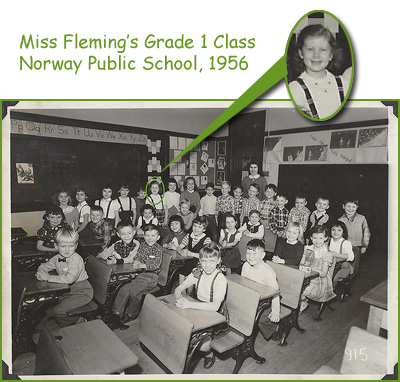
Norway Public School, circa 1955 | Public Domain photo
courtesy Toronto Public Library Archives

The hallways at Norway Public School smelled of paste and paint, of ink and floor wax (and sometimes, I soon discovered, of wet wool, old shoes, and sweaty boys). My first-day strategy was to look forlorn and say absolutely nothing. Between that and the floods of tears I couldn't seem to control, I figured they'd soon realize I didn't belong at school and send me home forever. It didn't quite work out that way.

The teacher, whose name remains a blank spot in my memory, tactfully ignored my streaming tears and sniffles, distracting me with a brand new box of crayons and a big sheet of construction paper. I didn't want to like her. I tried really, really hard not to like her. But when she admired my first drawing, I had to admit that perhaps she wasn't so mean after all. And when she pinned my drawing to the wall beside her desk, I might even have thought she was nice. But I still didn't want to be at school.


Recreation of my vividly remembered first drawing.

Being painfully shy, not to mention being the girl who cried, invariably meant I was last to be chosen for games of Red Rover or baseball. This wasn't entirely a bad thing – Red Rover scared me and baseball was downright dangerous on the cinder-covered schoolyard. I was happiest when I could avoid being chosen at all.

One of the big grade two boys liked to follow us younger kids around, 'accidentally' bump into us, and then steal our recess snacks. I had the scabby knees and cinder scars to prove it. My eventual revenge, though unintentional, was sweet.

Back in those days, I had a great little dog named Cookie. Every morning I'd tuck a Spratt's Oval dog biscuit into my jacket pocket as a special after school treat for her. One day bully-boy caught me checking it out and ran across the playground to confront me. I shoved the little biscuit back into my pocket.

"What'cha got there?" He grabbed my arm and fished out the biscuit. "Hiding a cookie, eh?"

I almost spoke. Almost told him it wasn't a cookie…

"Mine now," he said, and popped it into his mouth, crunching it up as he strutted away. And then he stopped, doubled over, and vomited on his shoes. 

I guess that can happen when you're expecting sweet ginger but get charcoal and liver instead. The bully never bothered me again. But I still didn't want to be at school.

Eventually I managed to get my tears under control (mostly) and by grade one I even worked up a smile in time for the class photo. But I still didn't want to be at school.

I was one of those kids who managed to catch every bug that made the rounds. For me, the best parts of the school year were those quiet days at home where Mom would install me on the living room sofa with colouring books, ginger ale, and green Jell-O to help me feel better. I liked it so much that I always stayed sick for a few days longer than was strictly necessary. If there was no bug making the rounds at school, I'd invent one. I even devised a way to make the thermometer read a few degrees higher than the truth when pulled from beneath my tongue. (My method remains a secret to this day, lest I corrupt a new generation of slackers!) 

In later years, I spent those lovely sick days lost in library books – Swallows and Amazons, Anne of Green Gables, and more. Somehow, despite many absences, I managed not only to pass every grade but to do so with report cards full of As and Bs. Of course, the teacher comment line always included some variation of, "Cheryl needs to work on her social skills." Followed by, "She has a vivid imagination." Tsk. Of course I had a vivid imagination. I spent most of my happy time hanging out there!

Everything changed in grade seven. I was packed off to a new school and a new class for bright, alternative learners – an experimental class that might, it was hoped, bring me out of my shell. (It didn't seem to matter that I quite liked my shell.)

Surprise number one: my new teacher was a man! I was terrified of Mr. Gibson for the first five minutes and, like everyone else in the class, a little bit in love with him ever after. And the surprises just kept coming. 

Mr. Gibson took us to visit his mother who demonstrated weaving on a gigantic loom in her attic. He introduced us to musical theatre with a trip to see The Mikado and follow-up singalongs of Gilbert and Sullivan patter. He brought fresh oysters and raw turnip to class and lined us all up for taste tests. (I liked the turnip but managed to stay at the end of the line until … uh-oh, no more oysters, oh well.)

Mr. Gibson didn't believe in exams. When we took tests, text books were always left open around the room and we were free to look things up. We rarely did. He encouraged us to experiment with science, art, and literature; to work in teams and form new friendships. I met a kindred spirit in that class – Kate, who remains my best friend after all these years. Most important of all, Mr. Gibson taught us to think for ourselves and then to be brave enough to say what we thought. We would've done just about anything for him. 


Unfortunately, most of the parents – my own included – thought Mr. Gibson was doing everything wrong, turning their sweet, bidable children into outspoken little monsters. His great experiment lasted only one year, but I was a part of it. And for the first and only time in my life, I wanted to be at school. Mr. Gibson, if you're still out there… thanks for the very best of times.


So, reader, are you a school lover or loather? Let me know in the comments. (But if you think you know how I spoofed the thermometer, best keep it to yourself. We wouldn't want to start an epidemic.)


Permalink: school dazed...


Postscript: I've just discovered that a young friend of mine had his first day of Junior Kindergarten yesterday at – you guessed it – Norway Public School! Today's Norway is a very different place from the old school I knew. The creepily Gothic building is gone and so are the dreadful cinders in the yard. Also gone are the first-day jitters and tears. My young friend looked forward to school all summer and, judging by the photos shared by his proud parents, he couldn't be happier there. And you know, after writing it all down I'm feeling a little better about the whole school experience myself. (But I still don't want to be there.)


Subscribe to stillpoint – You'll receive email notification when a new blog is posted, no more than once a week and absolutely no spam, I promise!


stillpoint is the blog of Canadian author Cheryl Cooke Harrington


Labels: , , , , , , , , , , , ,

Wednesday, August 31, 2016

mystery in my history...


I keep an antique chest beside my bed. It's small – only eight by twelve inches and five inches deep – and it's showing its age with bumps and scars. Even so, it's a real beauty, hand crafted from dark burled wood with mother-of-pearl inlay on the top and around the key hole. 


A hand lettered card glued inside the lid reads:

M. S. Gainfort
from I. Sawyer
Christmas
1867

I'll probably never know who I. Sawyer was. That detail is lost to the mists of time. But M. S. Gainfort was Margaret Susan, my maternal great-grandmother. I imagine she thought the beautifully polished box was a very fine gift. For me, though, the real treasures are the bits and pieces of history that dwell inside. Some of those bits and bobs have been puzzling me for a very long time. These, for instance... 

Puzzling bits and bobs. (Quarter included for scale.)

I remember how thrilling it was as a child to be allowed a peek inside that box. I loved the tiny boot with its secret compartment. What, I wondered, had the owner been able to hide in such a small space? A banded wood cylinder revealed another small hiding spot. Very odd. And what about the chunk of quartz? It looked like a stone I might find on the beach but... was that real, honest-to-goodness gold glistening on its surface? Most intriguing of all was the weird glass ball with numbers all around. Was there a Victorian era version of Dungeons and Dragons? Somehow I couldn't imagine great-grandma in the role of dungeon master.

Last week I peeked inside the box again and decided to do a bit of sleuthing. It's true what they say. You really can find everything on the Internet. Here's what I discovered...


My cute little boot with its secret compartment is probably a Georgian era snuff box. Snuff box collectors have pinned thousands of images at Pinterest, some of them incredibly ornate. Shoes were a popular shape and I spotted quite a few similar to this one. Mystery solved. (I'm left to wonder... who was the snuff user?)


I'd long suspected this little container may have held pencil leads. Research suggests I'm right. Some similar containers were large enough to hold a small mechanical pencil as well as spare leads.


Did I strike it rich or not? Alas, everything I found makes me think this is iron pyrite or fool's gold, not the real deal. Of course, the only way to be absolutely sure is to have it tested. I think I'll put it back in the box and let the dream live on.

Turns out this little Czechoslovakian crystal ball with its thirty-two numbered faces does exactly what you'd expect a crystal ball to do. It's a fortune teller. This was definitely a surprise and the best discovery of all, but I sure wish great-grandma had saved the instructions.


I managed to find a few photos of partial instruction sheets online and decided to give it a try. I chose "surprise" and rolled a nine. My fortune said:


"An old bag or trunk holds a hidden fortune for you."

Excuse me while I retrieve that hunk of quartz with the solid gold veins. I think I'd better take it to the bank.


Subscribe to stillpoint – You'll receive email notification when a new blog is posted, no more than once a week and absolutely no spam, I promise!


stillpoint is the blog of Canadian author Cheryl Cooke Harrington


Labels: , , , , , , , , , , , , ,

Wednesday, May 11, 2016

The Write Spot: Louisa Treger


Louisa Treger began her career as a classical violinist and worked as a freelance orchestral player and teacher. She subsequently turned to literature, gaining a PhD in English at University College London. Married with three children and a dog, she lives in London. The Lodger is her first novel.

I had the pleasure of reading The Lodger, shortly after its release and absolutely loved it. You'll find my review here

Giveaway: Louisa has generously offered to send an autographed hard cover copy of The Lodger to two lucky readers of this blog. [Update: Congratulations to the winners, Sara in Ontario and Terry in Missouri!]

Welcome, Louisa, to the twenty-first edition of The Write Spot, a bi-weekly author series spotlighting the many and varied places where writers write. 

Tell us a bit about your Write Spot.

I live in London, but my late mother was South African. I still have family and strong ties with South Africa, and I spend as much time as I can there. South Africa has always been the place I feel most alive in. And so, I decided to share my South African 'Write Spot' with you.


What makes it 'The Write Spot' is the view: the lushness of grass and rolling hills, the river, the quality of the light. I am lucky to have such inspiration before my eyes! Also, the room I work in is visually simple and uncluttered. It is in a remote and utterly peaceful area; there is no noise, other than from birds, no phone and no WiFi.


What a spectacular view! Other than your computer or laptop, what's the one thing you couldn't be without in your Write Spot?

Actually, there are three things! Foremost, my dog, Monty. He is the sweetest and most undemanding of writing companions, and he has become a necessary part of the process. I refer constantly to my notebook, which I carry round whenever I'm not writing to mop up all the words and ideas that come to me at odd moments. And I depend on a constant supply of strong coffee!

Monty looks like a real sweetheart. Honestly, between that face and the view beyond your window, I don't know how you get any work done!

What are you working on now?

I am writing my second novel. It’s about a girl who was part of the Kinderstransport – the rescue mission that brought thousands of refugee Jewish children from Nazi occupied Europe to safety in England. They left their families to go to the care of strangers, in a foreign country whose language they only had the barest grasp of. They didn't know what would happen to them, or if they would see their parents again. The novel describes how the girl and her descendants adjust to English life, and how the trauma of the Holocaust doesn't stop with the people directly affected by it, but spreads down through successive generations.

A fascinating topic, Louisa. I'm looking forward to reading it. Where can readers find out more about you and your books?

The link to my website is louisatreger.com

You'll also find me on social media at the following sites:


I love connecting with readers, so do reach out!


The Lodger by Louisa Treger is available now!

Dorothy exists just above the poverty line, doing secretarial work at a dentist's office and living in a seedy boarding house in Bloomsbury, when she is invited to spend the weekend with a childhood friend. Jane recently married a writer, who is hovering on the brink of fame. His name is H.G. Wells, or Bertie, as he is known to friends.

Bertie appears unremarkable at first. But then Dorothy notices his grey-blue eyes taking her in, openly signalling approval. He tells her he and Jane have an agreement which allows them the freedom to take lovers, although Dorothy is not convinced her friend is happy with this arrangement.

Reluctant to betray Jane, yet unable to draw back, Dorothy free-falls into an affair with Bertie. Then a new boarder arrives at the house – striking, unconventional Veronica Leslie-Jones, determined to live life on her own terms – and Dorothy finds herself caught between Veronica and Bertie. Amidst the personal dramas and wreckage of the militant suffragette movement, Dorothy finds her voice as a writer.

The Lodger is a beautifully intimate novel that is at once an introduction to one of the most important writers of the 20th century and a compelling story of one woman tormented by unconventional desires.


Buy The LodgerAmazon


About The Write Spot:
I've always been fascinated by what goes on behind the scenes. Whether it's backstage photos from my favourite play, a peek into the kitchen where a chef is working her culinary magic, or simply a glimpse through an uncurtained window into a stranger's private world, there's an undeniable thrill of discovery, a sense of secrets shared. It's no surprise, then, that I'm immensely curious about where other writers do their work. I've blogged about it before in this post about my own 'write spot' and so enjoyed the comments, I was inspired to launch a regular feature here at stillpoint. Watch for The Write Spot every other Wednesday and join me as I discover the many and varied places where writers write.


stillpoint is the blog of Canadian author Cheryl Cooke Harrington


Labels: , , , , , , , , , , , , , ,

Wednesday, February 10, 2016

when the hand is dust...


On a table beside my bed there's a burled walnut box full of treasures. Not jewels or gold. These treasures are all about family. In fact, the box itself is a treasure. Made for my great-grandmother as a Christmas gift in 1867, it has been passed down from mothers to daughters and, over the years, lovingly filled with little pieces of our history.


Noble Dickenson was my great-grandfather and this is his "Sundries Book". Leather-bound, with a little brass clasp, the book measures just 2 by 3-1/2 inches. Noble carried it with him from 1868 to 1870 as he travelled, worked, and saved for his future.

The earliest entries in the little journal are almost completely illegible now – time has taken its toll on the "indelible" pencil lead. Most of the readable entries are Noble's accounting records, income, expenses, and lists. But there are also moments of observation that bring his world to life. 

On March 29th, 1870, he wrote: "Noticed the first bluebirds of the year today on our way to split up an elm tree we felled in James Will's wood. Joe and I. No robins as yet observed." It must have been a long, cold winter in Norwichville, Ontario.

A month later, another interesting entry: "Notes of our journey to the States, April 22nd, 1870. Left Norwichville on the morning of the 21st. Roads in a [...] state with snow. Got into Woodstock at 1 o'clock same day. Had dinner or supper of carrots and started for Detroit in the night at 1 o'clock. Got into Windsor at 8 in the morning and crossed the river right away on the boat. Staw (sic) in Detroit until evening. Got tics. on the 5 […] for [ ....]  Willy rather cross. I thought vegetation in general was farther advanced than in Canada. From Detroit to G. Haven, from G. Haven to Muskegon, from Muskegon per [...] to Frankfort."


I believe Willy was Noble's brother William … and I'd probably be rather cross, too, if dinner after a long day of travel turned out to be carrots. Just carrots! (That can't be right, but the word sure looks like carrots to me.)

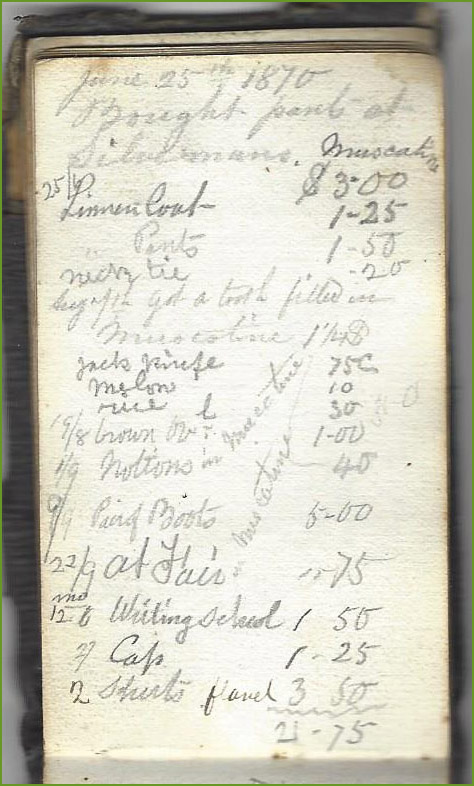
By June 25th of 1870, the brothers had arrived in the thriving metropolis of Muscantine, Iowa.

Muscantine engraving, 1865, Barber and Howe, Public Domain

Noble wrote, "Bought pants at Silvermans, Muscantine" and went on to list his purchases. Apparently I come by my love of shopping honestly – this is quite a list. It's quite a hefty expenditure, too, at a time when his earnings averaged 75 cents a day.


After his five month, 2500 km (1600 mile) journey, Great grandpa Noble Dickenson returned to Norwichville (now known as Norwich), Ontario where he served the town as Post Master until October of 1886. He married great grandma Margaret Gainfort on March 5th, 1871 and together they raised a family of nine – three boys and six girls. According to family lore, Noble and Margaret first met via telegraph, making theirs one of the world's first "online" romances.

I'm smitten. The ancestry bug has bitten and I'm feeling the pull to discover more secrets from the past. There are plenty of clues and starting places hiding in the little treasure box beside my bed, so stay tuned for more. (And, yes, I am writing a story about Noble and Margaret's telegraph romance. How could I possibly resist?)

What have you discovered about your family history?


Wondering where you've heard that before? The title of this post is a quote from My Autograph by Susanna Moodie (1803-1885):

"What—write my name!
            How vain the feeble trust,
            To be remembered
      When the hand is dust—"


stillpoint is the blog of Canadian author Cheryl Cooke Harrington
  

Labels: , , , , , , , , , , , , , , ,