stillpoint

musings from Canadian author Cheryl Cooke Harrington ... home of The Write Spot

Wednesday, May 18, 2016

chicken lessons...

It's not a proper homestead until the hens come home to roost. So, having survived our first winter on the farm, the spring of 1976 found us building ourselves a sturdy chicken coop.

Compared to the splendid backyard coops showcased in Country Living, ours might be kindly described as "rustic", but I always thought it a pleasant, welcoming place. Three multi-paned windows formed the south wall, above a hen-sized hatch and ramp. The west and north faces sported whitewashed board and batten siding, the east a human access door. The roof was steeply pitched, nattily shingled in a mostly-green patchwork. Doors, windows, and shingles were leftover odds and ends salvaged by hubby and my roofer brother-in-law. We learned to be frugal recyclers back in our days on the farm.

Inside the coop, six spacious, straw-filled nest boxes and a series of sleeping roosts spanned the back wall, with food and water stations opposite, on either side of the hatch. I remember standing in the newly-built coop for the first time, warm sunshine streaming through the windows, fresh straw rustling beneath my feet. A good place to be a chicken, I thought, and imagined easing my hand under a warm, contented hen to retrieve a fresh egg for breakfast. The only thing missing was a flock.


A Saturday morning trip to the local Farmer's Market solved that problem. In the bustling livestock area, we spotted a huddle of six red hens, retired working ladies who, according to the seller, still had plenty of good egg producing days ahead. With trimmed beaks and clipped wings, they certainly weren't the prettiest birds on the block but we liked them – and goodness knows they deserved a better life. We took them home. Upon seeing their new digs for the first time, our six ladies stood wide-eyed and open beaked for one surprised moment and then lunged, squabbling and clucking, for the food tray.

Lesson #1: Chickens have absolutely no manners and very tiny brains.

Instead of roosting on the thoughtfully provided perches, two of our six hens preferred to sleep in their nest boxes. Come morning, instead of choosing empty boxes with fresh, clean straw in which to lay their eggs, the rest of the ladies decided the occupied nests must be best and so they piled on. It's a wonder the eggs didn't wind up pre-scrambled.

Lesson #2: Easing your hand under a pile of warm, contented hens results in a wickedly pecked hand, three mightily disgruntled hens, and a couple of lovely brown eggs smudged with evidence of the previous night's chicken poop, thank you very much.


One of our girls was a rebel. We called her Ludlow. At first, she made a habit of dropping her egg-of-the-day wherever she happened to be standing at the time – usually on the bare floor in a corner of the coop, but sometimes out in the spacious fenced yard, well hidden from hungry humans. ("Cluck-cluck-cluck" sounds suspiciously like laughter when you're bent over, peering under burdock leaves.)

Within a month, though, hens and humans settled into a comfortable routine. Eggs were almost always deposited where we could easily find and collect them. And, oh, those eggs! The flavourful, bright orange yolks and firm whites were as different from pale, bland, watery supermarket eggs as our happy free range hens were different from their sad, battery-raised sisters. Some of our ladies regularly gifted us with giant double-yolkers. What bounty! We couldn't possibly eat all the eggs they produced, but neighbours were eager to buy whatever we couldn't use. Opportunity knocked. It was time to grow the flock.

We ordered two dozen baby chicks from the local farmer's co-op, half Leghorn and half Barred Rock. The day-old chicks were delivered in a big cardboard carton and when the lid came off – talk about cute! J and his brothers were beyond thrilled with our box of fluffy peepers. The chicks spent their first weeks of life confined to a comfy cage in our sunroom, eating, sleeping, peeping…pooping.


Lesson #3: Baby chicks may be the cutest things under the sun, but 24 of them together produce a mountain of poop. Also, they grow fast. Very fast.

Lesson #4: Between the fluffy baby chick stage and the handsome young chicken stage comes a gangly stage of ghastly pin-feathered ugliness. Also, just like their elders, chicks have absolutely no manners and very tiny brains.

Our sunroom smelled a whole lot better once the chicks moved outside. Their temporarily fenced-off corner of the coop had a baby-proof water fountain (because, given the opportunity, chicks will fall into their water and drown or be trampled by their siblings), a makeshift automatic feed tray (because chicks are non-stop eating machines), and a heat lamp to keep them all cozy at night.

Lesson #5: Temporary fencing keeps young chicks in but won't keep a fat Ludlow out when she's got her beady eyes locked on all that delicious baby food.

Weeks passed. Chicks ate and peeped and grew…and pooped. The youngsters sprouted sleek, shiny feathers. A few handsome lads grew impressive tail plumes, wickedly sharp ankle spikes, and youthful cocky attitudes. Crowing practice began every morning at dawn and continued throughout the day whenever the guys felt like showing off. Our peaceful chicken yard erupted in frequent rooster fights, sending hens young and old into frenzies of squawks and flaps as the males worked out who would be King of the Coop, the Alpha Rooster.


Lesson #6: Don't tease the rooster!

One of my most vivid memories of those early chicken days is the sight of our landlady's eight-year-old granddaughter, dressed in her prettiest pink Sunday dress with matching ribbons in her hair, running full-tilt down the lane, screaming for her mother. In hot pursuit was Lancelot, our newly crowned Alpha Rooster, puffed up to twice his normal size, looking and sounding like an angry, feathered demon from hell.

Turns out, Darling Girl had decided to have an uninvited snoop around the chicken coop and encountered Lancelot, loose in the yard. Spotting his impressive tail feathers, she decided she'd like to have one for herself. Cue one very angry rooster!

In a classic case of turnabout's fair play, Lance the Rooster was forced to beat a hasty retreat minutes later with an angry Italian grandmother hot on his heels, wielding her broom and cursing his ancestors.

Ah, farm life. Never a dull moment.


Permalink: chicken lessons…


Image credits:

Images are my own work with the exception of Fresh Eggs and Attack Rooster.  


stillpoint is the blog of Canadian author Cheryl Cooke Harrington
   

Labels: , , , , , , , , , , , , , ,

Wednesday, April 06, 2016

oh, traitorous nose!


Close your eyes and sniff:

lilacs
Photo by Marisa DeMeglio | CC-BY-2.0

On second thought, don't close your eyes. Just gaze upon the pretty lilacs and let your olfactory memory go to work.

For many people, the image alone will be enough to trigger a vivid scent memory, a scent likely to conjure thoughts of springtime, sunshine, warm breezes and gentle rain.

I should be so lucky.

Oh, the lilac image does trigger a scent memory for me, no doubt about that. But no sweetly perfumed breezes come to mind. Instead, my traitorous nose conjures a dank and earthy funk.

It all began on a warm spring afternoon in 1986. Friends and family had been invited to the farm for a celebration of my parents' wedding anniversary. After days of intense preparation, the feast was ready. Our little house looked bright and fresh as could be. Even our three rambunctious sons had been scrubbed clean. As party hour drew near, I took a moment alone to admire the table. Set with grandma May's treasured Limoges china and our special occasion crystal glassware, it sparkled, ready for company.

"Mom!" The screen door slammed and middle son bounded into the house looking slightly less scrubbed than I remembered. "Dad wants to know if—"

He fell suddenly silent, his smile fading away and his nose wrinkling. Before I could ask what was wrong, he took a giant step back and said, in a horrified tone, "It smells bad in here, Mom."

As I moved to join him in the hallway, I caught a whiff of it, too. And there was no mistaking that smell. Dead mouse.

Mice are an inescapable fact of country life and, for the most part, we chose to live and let live, as long as the mice chose wisely and stayed outside. Inside, they were rodent non grata and definitely not welcome at our party, dead or alive.

Middle son rounded up his brothers and we organized a search. The odour was strongest in the front hall and near the cellar stairs but despite poking, prodding, and sniffing in every possible nook and cranny we had no luck finding the stinky culprit. Our guests were due to arrive in less than an hour. The smell was growing stronger by the minute. What to do?

The day was warm, with a gentle, steady breeze, so my first step was to open all the windows. That's when middle son remembered what he'd been sent to ask me. "Do you want Dad to cut some lilacs for the house?"

Yes! Our lilac hedge had some of the most aromatic flowers I'd ever encountered. Their sweet, long-lasting fragrance was exactly what we needed to disguise the presence of a not-so-dearly departed mouse. While I pulled out every vase I could find, plus a few big mason jars for good measure, the boys helped their dad cut lilacs. Masses and masses of lilacs. We placed them in the front hallway, beside the cellar door, in the living room and sunroom—even in the bathroom. They looked lovely and, more important, they smelled lovely… like springtime.

The party was a success—great company, good food, happy times. Everyone loved the lilacs. We even sent bunches home with a few people. Only later, with windows closed against the cool evening air, did the scent of mouse begin to insinuate itself again, mingling with the fragrance of cut lilacs until the two smells became one.

Days passed. As the flowers faded, so did their fragrance. The smell of death faded, too, and we never did find the mouse. Its dry bones remain entombed forever inside the walls of that old house.

lovely lilacs
Liam Moloney | CC-BY-SA-2.0

The following year when the first lovely lilacs burst into bloom in our garden, I was eager to visit them, to bury my face in the pale purple flowers and revel in the scent of springtime. That's when I first discovered the awful olfactory truth. And thirty years later, that truth still applies. For me, the sweet, heady perfume of lilacs will always carry a base note of mouse.

mouse


Mouse image by George Shuklin | CC-BY-SA-1.0


stillpoint is the blog of Canadian author Cheryl Cooke Harrington


Labels: , , , , , , , , , , , , , , ,

Wednesday, February 10, 2016

when the hand is dust...


On a table beside my bed there's a burled walnut box full of treasures. Not jewels or gold. These treasures are all about family. In fact, the box itself is a treasure. Made for my great-grandmother as a Christmas gift in 1867, it has been passed down from mothers to daughters and, over the years, lovingly filled with little pieces of our history.


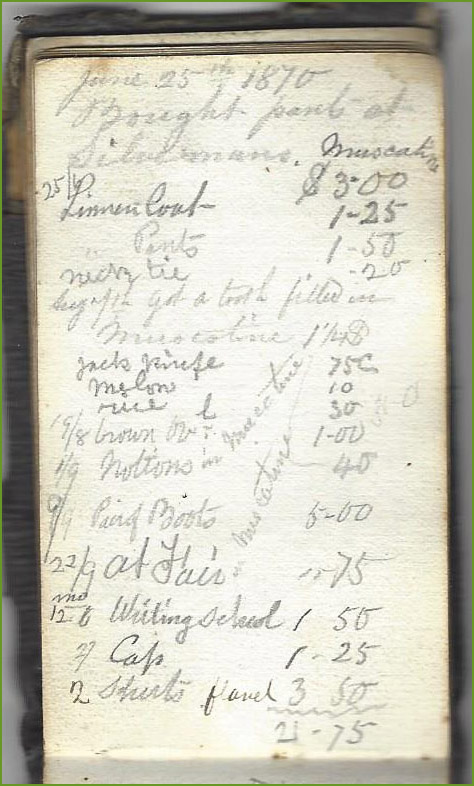
Noble Dickenson was my great-grandfather and this is his "Sundries Book". Leather-bound, with a little brass clasp, the book measures just 2 by 3-1/2 inches. Noble carried it with him from 1868 to 1870 as he travelled, worked, and saved for his future.

The earliest entries in the little journal are almost completely illegible now – time has taken its toll on the "indelible" pencil lead. Most of the readable entries are Noble's accounting records, income, expenses, and lists. But there are also moments of observation that bring his world to life. 

On March 29th, 1870, he wrote: "Noticed the first bluebirds of the year today on our way to split up an elm tree we felled in James Will's wood. Joe and I. No robins as yet observed." It must have been a long, cold winter in Norwichville, Ontario.

A month later, another interesting entry: "Notes of our journey to the States, April 22nd, 1870. Left Norwichville on the morning of the 21st. Roads in a [...] state with snow. Got into Woodstock at 1 o'clock same day. Had dinner or supper of carrots and started for Detroit in the night at 1 o'clock. Got into Windsor at 8 in the morning and crossed the river right away on the boat. Staw (sic) in Detroit until evening. Got tics. on the 5 […] for [ ....]  Willy rather cross. I thought vegetation in general was farther advanced than in Canada. From Detroit to G. Haven, from G. Haven to Muskegon, from Muskegon per [...] to Frankfort."


I believe Willy was Noble's brother William … and I'd probably be rather cross, too, if dinner after a long day of travel turned out to be carrots. Just carrots! (That can't be right, but the word sure looks like carrots to me.)

By June 25th of 1870, the brothers had arrived in the thriving metropolis of Muscantine, Iowa.

Muscantine engraving, 1865, Barber and Howe, Public Domain

Noble wrote, "Bought pants at Silvermans, Muscantine" and went on to list his purchases. Apparently I come by my love of shopping honestly – this is quite a list. It's quite a hefty expenditure, too, at a time when his earnings averaged 75 cents a day.


After his five month, 2500 km (1600 mile) journey, Great grandpa Noble Dickenson returned to Norwichville (now known as Norwich), Ontario where he served the town as Post Master until October of 1886. He married great grandma Margaret Gainfort on March 5th, 1871 and together they raised a family of nine – three boys and six girls. According to family lore, Noble and Margaret first met via telegraph, making theirs one of the world's first "online" romances.

I'm smitten. The ancestry bug has bitten and I'm feeling the pull to discover more secrets from the past. There are plenty of clues and starting places hiding in the little treasure box beside my bed, so stay tuned for more. (And, yes, I am writing a story about Noble and Margaret's telegraph romance. How could I possibly resist?)

What have you discovered about your family history?


Wondering where you've heard that before? The title of this post is a quote from My Autograph by Susanna Moodie (1803-1885):

"What—write my name!
            How vain the feeble trust,
            To be remembered
      When the hand is dust—"


stillpoint is the blog of Canadian author Cheryl Cooke Harrington
  

Labels: , , , , , , , , , , , , , , ,

Wednesday, January 27, 2016

easy wind and downy flake...

Toronto hasn't seen much snow this winter – yet. But the monster blizzard that battered the east coast this past weekend has me reminiscing about past winters and life in simpler times.

Not that there was ever anything "simple" about enduring massive snowfalls, ice storms, and power outages. But I can't help wondering if our always-connected, always turned on twenty-first century life means we have a harder time coping when the inevitable happens. And then I wonder . . . what if the grid goes down and stays down? Zombie apocalypse, anyone?

Back in my hippy-back-to-the-land days of the 1970s and 80s, my husband and I and our three young sons lived in a rented farm house with several acres of land and a ramshackle barn. We moved to our farm on a snowy day at the end of December in 1975. I'll never forget arriving there with our overloaded camper van, and several carloads of city-folk friends to find the long gravel driveway completely drifted in. Hubby made a run at it with the van and, by some miracle, managed to stay on the track. After a few more runs, he'd cleared enough of a path for the rest of the convoy to follow. Our friends unloaded their vehicles in record fast time and beat a hasty retreat to the city, no doubt convinced we'd lost our minds. There were times, during that first challenging winter, when I wondered if they might be right.

A cranky old octopus of an oil furnace lurked in the cellar where it struggled to deliver heat to the first floor. Upstairs bedrooms were always cold but we piled on extra blankets and told ourselves the bracingly fresh air that gusted through our ancient sash windows made for healthy sleeping. (In fact, it probably saved our lives. I'm sure that furnace was pumping out clouds of carbon monoxide along with its meagre heat.)

We installed a massive cast-iron stove before our second winter on the farm, partly for the ambiance of a wood fire but mostly because we weren't sure the old furnace would see us through another season. We were right about that. For the next sixteen years, we relied on a Fisher stove like this one to keep us warm – hard work, sometimes, but worth it.

In late summer, a truck would deliver seven bush cords of wood, dumping it unceremoniously at the end of the driveway. We (and by "we" I mean mostly hubby) became skilled at splitting logs into manageable chunks, obsessive about hunting down kindling – fallen cedar branches from the neighbour's woodlot were best – and expert at stacking the split cords in neat, shoulder-high rows to dry. Our sons still grumble about the brutal Two Load Rule: each boy had to carry two big armloads of firewood into the house before settling down to their after school snacks. The rule applied equally to me and their Dad, of course, but the child labour angle makes for better stories, all of them starting, "Why, when I was a boy . . ." The care and feeding of that wood stove became the stuff of family legends.

First person up on a winter's morning (again, almost always hubby) would hustle down to poke the embers and get a fire going to warm things up for the rest of us. The kids would huddle around the stove while they waited for breakfast. Unfortunately, eldest son had a habit of presenting his backside to the stove. There were a few times he got a bit too close. We teased him that we didn't need marks on the wall to tell us how much he'd grown in a year, we could just check the red stripes on his behind.

One particularly cold morning, with the boys off to school and the main floor feeling toasty warm, I decided to treat myself to a hot, relaxing bath. We always kept the plug in the bathroom drain because the tap had an intermittent drip and the drain had a habit of freezing. Sure enough, that morning there was a shallow puddle trapped in the tub. When I reached for the plug to release the water, my fingers skated across a solid sheet of ice. I changed my mind about the bath.

The following summer, with our landlord's blessing, we knocked that old tub room off the back of the house and built a new, well-insulated bathroom and a lovely big sun room in its place. Not only was that sun room the best reading spot I've ever had, it was perfect for starting seedlings in the spring and made a glorious heat trap on sunny winter days.

It's possible I'm seeing those long ago winters through the rose coloured glasses of fond memory, but I'm positive snow was deeper – and fell more often – in those early days on the farm. Corn stubble in the surrounding fields disappeared under a blanket of white in November and wasn't seen again until April. We could step out the back door, strap on our cross country skis, and take off for a trek through the woods. The kids loved the adventure of it, learning how to start a fire in the snow and savouring a picnic lunch in the wild.


These days, we're all city dwellers, but a recently acquired plot of land has us dreaming and scheming. Far from the city lights and off the grid, the property has fertile fields, a scrap of forest, and a tiny cold water lake. We're in no rush to give full time back-to-the-landing another try; we like our internet and city comforts a bit too much. But I have to admit, there's also comfort in knowing we've done it before and, if we need to, we know how to do it again. Hopefully without zombies.


Wondering where you've heard that before? The title of this post is a quote from Stopping by Woods on a Snowy Evening by Robert Frost:


"The only other sound’s the sweep

of easy wind and downy flake."


stillpoint is the blog of Canadian author Cheryl Cooke Harrington


Labels: , , , , , , , , , , , , , ,

Wednesday, December 09, 2015

sneaky peekers

Temptation. That's the trouble with this time of year. Too many temptations. And it's not just the chocolate and shortbread and all the other delectable holiday goodies on offer. No. I'm talking about surprises. All those hidden gifts, lurking in closets or squirrelled away in somebody's sock drawer. If you think about it, presents are not very good at keeping themselves secret. You can almost hear them whispering as they wait for the Big Day. "Look at me! Look at me!"

Of course, now that I'm a proper grown-up, I use my proper grown-up willpower to avoid closets, sock drawers, and other hidey-holes in the weeks leading up to Christmas. Even so, I'm always relieved when the last gift is bound up in shiny paper, tied with bright ribbon, and nestled safely under the tree. It's so much easier, then, to resist the temptation to peek. Okay, I might try to catch a glimpse of a hand-written tag, or maybe move a few packages around. You know, just to make room for more, not to shake or sniff or weigh a box with my name on it or anything. Ah-hem. Certainly not! It's all about the surprise, right? But…

Once upon a very long time ago, "willpower" was just a word grown-ups used when what they really meant was, "stop having all that fun!"

It was December, 1959, two weeks before Christmas. I was nine and a half years old. Mom was out for the afternoon, Dad was busy in his basement workshop, and I was hearing gift-whispers all over the house. With Cookie the dog as my trusty lookout, I tiptoed from room to room. Like a young Nancy Drew with her Togo, we were hot on the trail of a Christmas mystery. First, we checked the hall closet, rummaging through a box of scarves and mittens, behind the winter coats and under the boot rack – nothing. Upstairs, we rooted through the linen closet, opened Mom's lingerie drawer, and peered under beds – still nothing. My gift had to be somewhere in the house, I could definitely hear it whispering. In fact, by then, I was pretty sure I could hear it singing and giggling, too. "Tee-hee-hee and ho-ho-ho, you won't find me, no matter where you go." Cookie's tail seemed to keep time with a jolly thump-thump-thump on the floor. Whose side was she on, anyway?

Back in the kitchen, I pondered the situation while staring out the window at our snow-covered backyard. Birds fluttered and squabbled at the feeder. A cold wind rattled bare branches against the frosted windowpane. Downstairs, Dad whistled as he swept his workshop floor. Beside me, Cookie yawned and huffed, turning lazy circles before settling onto her mat for a nap. And the whispering gift had grown so quiet I could barely hear it any more. Ah-ha! What do you do when you're hiding and the seeker comes close? Hold your breath. Stay quiet. Don't whisper. I turned to study the kitchen. Where would I hide? Not in the cupboards or cutlery drawers – too much traffic – but what about the junk drawer?

Dry wood squealed a warning as I pulled it open. I froze. Cookie snored. Dad whistled. I held my breath and eased the drawer wide. There, tucked into a corner and poorly camouflaged by a jumble of elastic bands, playing cards, envelopes and postage stamps, was a neatly folded piece of crisp, white paper. The whispering stopped. I reached for the paper, carefully unfolded it, and read. This was it! Not the gift itself, but a receipt dated three days before, for "one transistor radio, pink."

Dad's footsteps sounded on the basement stairs. Cookie scrambled to her feet and ran to meet him at the kitchen door. I must have re-folded the paper and closed the drawer but I don't remember doing so. I managed to forget about the whispers and my afternoon of sleuthing, too. Until, gathered around our tree on Christmas morning, my parents put that perfect little gift in my hands. I looked up at their happy faces, so eager to see my surprise and delight, and all I could think of was "one transistor radio, pink."

Smile, I told myself. Act surprised. Don't let them know. I pulled on the ribbon, peeled back the paper, opened the box… and burst into tears.

I'd like to think that Mom and Dad never suspected I'd peeked, that they believed my tears were tears of happiness, that I hadn't disappointed them. But I have a feeling they both knew exactly why I was crying. I loved that pink transistor radio and made sure they knew it. But my sneaky peeking had, in some small way, spoiled the celebration – not only for me, but for the people who loved me best.

So, take it from me. No matter how many gift whispers you might think you hear this holiday season, don't become a sneaky peeker. Get yourself some proper grown-up willpower and savour the surprise.


Merry Christmas, everyone!


Permalink to this post: sneaky peekers


stillpoint is the blog of Canadian author Cheryl Cooke Harrington


Labels: , , , , , , , , , , , , ,

Wednesday, October 28, 2015

The White Lady of Box Grove, a true ghost story

Sunday, December 15, 1975

"Mommy?"

Adam's voice came in a tight whisper, an instant response to the squeak of floorboards as I climbed the stairs. It was our second night in the old rented farmhouse and my not-quite-three-year-old son was restless in unfamiliar surroundings.

"Coming," I whispered back, hoping we wouldn't rouse his baby brother.

Adam looked up, eyes full of worry, as I bent to tuck in his covers. "Sing me a song?"

"Sure. Just one, though. It's my bedtime, too." I settled on the edge of his bed and gave him a quiet rendition of his favourite, You Are My Sunshine.  "Okay, now?"

"I guess." He didn't sound too sure about the state of his okay-ness, so I sat for a moment longer, my hand resting gently on his arm.

"Where'd that lady go?"

"What lady, hon?" This was a puzzler. We hadn't seen a soul all day. Not since late the night before, when the friends recruited to help with our move from Toronto dropped off the last boxes.

"The white lady." Adam pointed across the room. "She was there."

A chill spidered its way up my spine as I turned to follow his sleepy gaze. In the corner of the room, three-month-old Matthew nestled peacefully in his crib, sound asleep.  No lady. I let go of the breath I'd been holding and turned back to Adam. "When was this, sweetie?"

"I woke up," he said, sounding peevish now. "She was looking at Matty again. I said hi and she did this," Adam lifted one finger to his lips in a shushing gesture. "Then I heard you. And then I looked and she was gone. Is she your friend?"

I stroked his hair, hoping he wouldn't notice the trembling of my hand. "I think you must've been dreaming." I certainly hoped he'd been dreaming. Thoughts of other, more ghostly, explanations for a strange lady in white seemed to swarm and scuttle through my mind.

"No," said Adam. "I told you. I woke up. She came last night, too, but you were asleep."

Gooseflesh prickled up my arms. Across the room, baby Matthew grumbled and stretched. "Well," I said, trying to sound a lot braver than I felt, "she's not here now."

"Did she go home?" he wondered, scanning the room once more.

"Home to bed," I whispered. And hoped with every fibre of my being it was the truth.

"Good," he said. "She was tired." And with that astounding statement, Adam's eyes drifted shut.

I didn't sleep at all that night. After relating the whole, spooky story to my husband, I'd insisted the two of us make a top-to-bottom search of the house. Our dog trailed along from room to room, looking baffled and sleepy but only raising her hackles once, when a mouse peeked out from beneath the fridge. No unseen, unearthly presence. No odd feelings. No lady in white.

Adam never mentioned the lady again. Whenever his Dad or I tried to bring the subject up, he acted as if he'd forgotten all about it. Winter turned to spring and we settled into life in the sleepy Ontario hamlet of Box Grove, enjoying our drafty but definitely not haunted country home.


Months later, my husband paid a visit to a neighbouring farm in search of nesting straw for our chickens. He returned looking a bit unsettled. After some coaxing, he related this conversation with the old farmer.

"Everything okay over at your place, then? Nothing… strange?"

Strange? At first, hubby thought the farmer meant the strange kind of science involved in hen husbandry or septic tank maintenance. But, no.

"They say it's haunted, that place of yours. Last folks didn't stay long. But now you're there, fixing things up… well, maybe things have changed. Maybe the White Lady likes you."

Cue goosebumps.

I like to think the White Lady did like us. Hadn't Adam said his lady was tired? Perhaps knowing the old homestead was loved and cared for once again gave her peace. Perhaps, with us, the White Lady of Box Grove finally found her rest.


True story. Happy Halloween!


Update: This story was published in the 2015 Halloween edition of the Markham Economist & Sun newspaper.


stillpoint is the blog of Canadian author Cheryl Cooke Harrington


Labels: , , , , , , , , , , , , , , , ,

Wednesday, October 14, 2015

man vs squirrel, a true story...


October is Squirrel Awareness Month. Who knew? I'm not sure who founded this month-long squirrelly love-fest. Even the great Google doesn't provide a definitive source, although there are plenty of squirrel appreciation links and enough cutesy photos to make even the most jaded among us crack a smile. So, are we expected to place tribute offerings of nuts and gourds at the base of the nearest oak? Fly fake squirrel tails from car antennae and flag poles? Post "up with squirrels" avatars on our social media profiles? I'm game, being quite fond of the wee beasties myself. But, I confess, my first thought when the news popped up in my Twitter feed was, "thank goodness my Dad's not around to see this."

Dad, you see, had a great big chip on his shoulder when it came to squirrels. It wasn't always the case. In fact, I vividly remember him laughing along with my toddler self at the twitchy-tailed antics of the troop in our neighbourhood park, even taking along some peanuts to feed the little guys. But that was before The Awful Awning Incident.

This is the awning in question. It graced the front of my childhood home on Haslett Avenue in Toronto, and it was Dad's pride and joy. In fact, everything about that house was Dad's pride and joy. He'd spend hours pruning and mowing, painting and polishing. No weeds need apply to Dad's gardens. Fallen leaves dare not linger on the sidewalk. Windows sparkled, paint gleamed, and the green and white stripes on that lovely canvas awning shone bright in the summer sunshine.

Our neighbours in the other half of the brick semi had no need for awnings, shaded as they were by the towering Norway maple that stood, majestic, in the middle of their tiny lawn. A few overhanging branches are visible in the photo but, for the most part, the tree kept to its side of the shared front walk, thus avoiding arboreal confrontations between Phyllis and Phil, my adorably named parents, and our equally adorably named neighbours Millie and Mel. (It's true. You can't make this stuff up.)

I loved that big tree with its spreading branches and mossy trunk. In spring, I'd spend hours sprawled on the cool grass watching maple seeds helicopter their way to earth. In autumn, the world became a bright kaleidoscope of falling leaves. Best of all, the tree was home to a happy tribe of squirrels who spent their days playing tag and scolding the neighbourhood dogs.


I was eight the year of The Awful Awning Incident. We'd returned late the previous night from our annual family vacation in cottage country. The last few weeks had been rainy and cool but this first morning home dawned sunny, hot, and humid. Mom was sorting laundry in the kitchen. I was at the table, listening to the snap-crackle-pop of my breakfast cereal and looking forward to taking my library book to the verandah and settling in for a morning with Swallows and Amazons. Dad was already out there, sweeping the floor and setting up the folding chairs. I heard the familiar squeak-squeak-squeak of the pulley as he lowered the awning. And then…

A wild, unearthly bellow echoed down the hall, followed by a series of chatters and thumps, and a string of turn-the-air-blue words I can't bring myself to repeat.

After a moment of stunned silence, Mom dropped her laundry basket and ran for the front of the house with me close on her heels. We burst through the screen door and stopped short at the sight of Dad, who was waving his arms and sputtering. "Look!" He pointed a shaking finger at the awning. "Just-just… look at what those bloody squirrels have done!"

We looked. A band of ragged, gaping holes marred the entire width of our beautiful awning. Balls of fluff, leaves, twigs, and fur littered the steps and flower bed. On the lawn, one very large and very angry daddy squirrel chattered insults at my increasingly red-faced father. Mrs. Squirrel and the kits had scrambled to safety in the maple tree but her mister was hopping mad about the abrupt eviction from their squirrelly B&B.

Photo by Doug88888 via Flickr | CC-BY-NC-SA-2.0

Dad never forgave those squirrels. He certainly never carried peanuts to the park again. His rage became the stuff of Haslett Avenue legends. No pesky varmints were going to outwit Phil Cooke.

"Leave your awning down all the time," suggested one neighbour.

"Roll it up with mothballs inside," offered another.

"Well, you could always just plant a nice, big tree," said Millie and Mel. (I'm pretty sure their hobby was bear-poking.)

Life quickly returned to normal for the squirrels, high in their treetop den, but the Cooke family went without shade for the rest of that long, hot summer. The following spring, workers arrived to install a shiny new green and white striped awning. Aluminium this time. I can still see my Dad standing on the front steps, one hand on his full metal awning, as he glared a challenge into the top branches of the big maple tree. "Let's see you blighters chew on that," he said.


Happy Squirrel Awareness Month, everyone!


Permalink to this post: man vs squirrel, a true story...

stillpoint is the blog of Canadian author Cheryl Cooke Harrington

Labels: , , , , , , , , , ,