stillpoint

musings from Canadian author Cheryl Cooke Harrington ... home of The Write Spot

Wednesday, September 21, 2016

a tree worth hugging...


"I think that I shall never see a poem lovely as a tree."* Yes, it's true. I'm a tree hugger. I've always felt a deep affinity for anything with branches. But there's a special place in my heart reserved for one particular spruce – the heroic tree that saved my family's home.


It was a sticky-hot afternoon in the summer of 1985. My three young sons and I were picking peas in our farm garden when a fierce and unexpected storm blew in across the fields. We ran for the house with rain pelting our backs. Wind ripped the door from my hands as we struggled to get inside, and then slammed the door behind us with an angry gust. We stood gasping and dripping in the middle of the room as the storm raged around us, rattling windows and battering the shingles until our little house trembled like leaves on an aspen. When the first flash of lightning split the suddenly dark sky, the answering boom of thunder seemed ominously close.


Photo by Brandon Morgan via Unsplash

The kids were frightened and so was I – I've never liked thunderstorms and this one was a doozie. But I pasted on what I hoped was a brave face, gathered them close, and told them not to worry, we would keep each other safe. I had barely formed the words when a flash of dazzling blue light and a massive BANG-crack assaulted our senses. The air around us seemed to sizzle, our ears popped, and the hairs on our arms prickled to attention. In one surreal moment, the plastic thermostat casing flew off the wall and struck my eldest son in the forehead. A trickle of blood leaked from his wound as we stood there, trembling and holding each other tight. A final gust of wind rattled the windows and the storm roared away as quickly as it had arrived.

After a quick head check and a Band-Aid for number one son, the four of us ventured outside. Instead of the usual after-storm freshness, the sharp tang of burnt wood filled the air. Lightning had found the highest point on the farm: one of three mature spruce trees in the yard. That poor tree was split from top to bottom. Wisps of smoke rose from the jagged scar and charred wood chips littered the lawn. Electricity had run to ground through the tree's roots, jumped to the plumbing that crossed the yard from well to house, burned out the water pump in the basement, and then surged through the electrical system to launch the freaky flying thermostat.

We'd had a close call. I'll always be grateful to that majestic spruce for taking the hit, because the second highest point on the farm – mere feet away from the tree – was the chimney on the roof of our beautiful little house.


Harrington House in Box Grove, Ontario circa 1990
Painting by Jorge Nascimento

I don't have a photo of my heroic spruce to share but I hope you'll enjoy this slideshow of other trees I've loved. Click on the player to start/advance the show.


Permalink: a tree worth hugging...


*Poem fragment from Trees by Joyce Kilmer.


Subscribe to stillpoint – You'll receive email notification when a new blog is posted, no more than once a week and absolutely no spam, I promise!

stillpoint is the blog of Canadian author Cheryl Cooke Harrington


Labels: , , , , , , , , ,

Wednesday, September 07, 2016

school dazed...


On a scale of one to ten, where ten meant "favourite thing ever" and one meant "bane of my existence", school consistently ranked a lowly one or two in my books. Sometimes it managed to slide right on down into negative numbers. Mine was a passionate aversion. So intense that, even now, decades after leaving the hallowed halls forever, I'm still haunted by the icy fingers of anxiety at this time of year.


Suddenly I'm five years old again, horrified by the fading summer, by the looming menace of the great unknown, by… The First Day of School. The situation required a firm stand. "No school for me," I told Mom and Dad. "I don't want to." It may have been more like foot stamping than firm standing.

My parents, bless them, tried gentle encouragement and even a bit of bribery. They said I'd make lots of new friends. ("Don't want new friends. I'm shy."). They hinted at wonderful new toys and games to play. ("I like my toys.") They promised I'd love my teacher. (I won't! She's mean!) They offered new shoes and a pretty new outfit. (Tempting, but… "I won't go and you can't make me!")

I can only imagine how exasperated they must have been when, after weeks of cajoling, they finally resorted to, "Enough! You have to go to school. It's the law." 

I consulted the neighbour kids, Linda and Billy. Older than me and wise in the ways of school and the law, they filled my head with whispered tales of truant officers and reform school – a dismal place with bars on the windows and stale bread with tepid water for dinner.

And so, on a fateful September Tuesday, I marched (not so) bravely up the street, wearing my crisp white blouse, swishy plaid skirt, and shiny new shoes. Mom pep-talked me all the way to school, holding tight to my hand in case I might bolt for home. I didn't want to cry, but by the time we reached the school yard, my face was wet with tears and each breath came in a tight sob. 

Life as I knew it was over.


Norway Public School, circa 1955 | Public Domain photo
courtesy Toronto Public Library Archives

The hallways at Norway Public School smelled of paste and paint, of ink and floor wax (and sometimes, I soon discovered, of wet wool, old shoes, and sweaty boys). My first-day strategy was to look forlorn and say absolutely nothing. Between that and the floods of tears I couldn't seem to control, I figured they'd soon realize I didn't belong at school and send me home forever. It didn't quite work out that way.

The teacher, whose name remains a blank spot in my memory, tactfully ignored my streaming tears and sniffles, distracting me with a brand new box of crayons and a big sheet of construction paper. I didn't want to like her. I tried really, really hard not to like her. But when she admired my first drawing, I had to admit that perhaps she wasn't so mean after all. And when she pinned my drawing to the wall beside her desk, I might even have thought she was nice. But I still didn't want to be at school.


Recreation of my vividly remembered first drawing.

Being painfully shy, not to mention being the girl who cried, invariably meant I was last to be chosen for games of Red Rover or baseball. This wasn't entirely a bad thing – Red Rover scared me and baseball was downright dangerous on the cinder-covered schoolyard. I was happiest when I could avoid being chosen at all.

One of the big grade two boys liked to follow us younger kids around, 'accidentally' bump into us, and then steal our recess snacks. I had the scabby knees and cinder scars to prove it. My eventual revenge, though unintentional, was sweet.

Back in those days, I had a great little dog named Cookie. Every morning I'd tuck a Spratt's Oval dog biscuit into my jacket pocket as a special after school treat for her. One day bully-boy caught me checking it out and ran across the playground to confront me. I shoved the little biscuit back into my pocket.

"What'cha got there?" He grabbed my arm and fished out the biscuit. "Hiding a cookie, eh?"

I almost spoke. Almost told him it wasn't a cookie…

"Mine now," he said, and popped it into his mouth, crunching it up as he strutted away. And then he stopped, doubled over, and vomited on his shoes. 

I guess that can happen when you're expecting sweet ginger but get charcoal and liver instead. The bully never bothered me again. But I still didn't want to be at school.

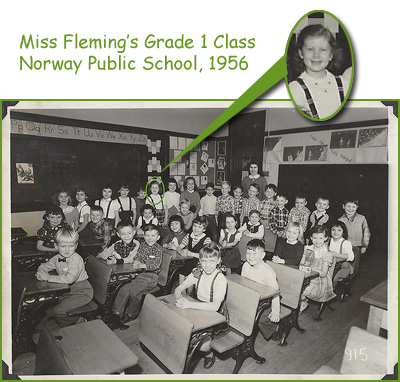
Eventually I managed to get my tears under control (mostly) and by grade one I even worked up a smile in time for the class photo. But I still didn't want to be at school.

I was one of those kids who managed to catch every bug that made the rounds. For me, the best parts of the school year were those quiet days at home where Mom would install me on the living room sofa with colouring books, ginger ale, and green Jell-O to help me feel better. I liked it so much that I always stayed sick for a few days longer than was strictly necessary. If there was no bug making the rounds at school, I'd invent one. I even devised a way to make the thermometer read a few degrees higher than the truth when pulled from beneath my tongue. (My method remains a secret to this day, lest I corrupt a new generation of slackers!) 

In later years, I spent those lovely sick days lost in library books – Swallows and Amazons, Anne of Green Gables, and more. Somehow, despite many absences, I managed not only to pass every grade but to do so with report cards full of As and Bs. Of course, the teacher comment line always included some variation of, "Cheryl needs to work on her social skills." Followed by, "She has a vivid imagination." Tsk. Of course I had a vivid imagination. I spent most of my happy time hanging out there!

Everything changed in grade seven. I was packed off to a new school and a new class for bright, alternative learners – an experimental class that might, it was hoped, bring me out of my shell. (It didn't seem to matter that I quite liked my shell.)

Surprise number one: my new teacher was a man! I was terrified of Mr. Gibson for the first five minutes and, like everyone else in the class, a little bit in love with him ever after. And the surprises just kept coming. 

Mr. Gibson took us to visit his mother who demonstrated weaving on a gigantic loom in her attic. He introduced us to musical theatre with a trip to see The Mikado and follow-up singalongs of Gilbert and Sullivan patter. He brought fresh oysters and raw turnip to class and lined us all up for taste tests. (I liked the turnip but managed to stay at the end of the line until … uh-oh, no more oysters, oh well.)

Mr. Gibson didn't believe in exams. When we took tests, text books were always left open around the room and we were free to look things up. We rarely did. He encouraged us to experiment with science, art, and literature; to work in teams and form new friendships. I met a kindred spirit in that class – Kate, who remains my best friend after all these years. Most important of all, Mr. Gibson taught us to think for ourselves and then to be brave enough to say what we thought. We would've done just about anything for him. 


Unfortunately, most of the parents – my own included – thought Mr. Gibson was doing everything wrong, turning their sweet, bidable children into outspoken little monsters. His great experiment lasted only one year, but I was a part of it. And for the first and only time in my life, I wanted to be at school. Mr. Gibson, if you're still out there… thanks for the very best of times.


So, reader, are you a school lover or loather? Let me know in the comments. (But if you think you know how I spoofed the thermometer, best keep it to yourself. We wouldn't want to start an epidemic.)


Permalink: school dazed...


Postscript: I've just discovered that a young friend of mine had his first day of Junior Kindergarten yesterday at – you guessed it – Norway Public School! Today's Norway is a very different place from the old school I knew. The creepily Gothic building is gone and so are the dreadful cinders in the yard. Also gone are the first-day jitters and tears. My young friend looked forward to school all summer and, judging by the photos shared by his proud parents, he couldn't be happier there. And you know, after writing it all down I'm feeling a little better about the whole school experience myself. (But I still don't want to be there.)


Subscribe to stillpoint – You'll receive email notification when a new blog is posted, no more than once a week and absolutely no spam, I promise!


stillpoint is the blog of Canadian author Cheryl Cooke Harrington


Labels: , , , , , , , , , , , ,

Wednesday, June 29, 2016

a memory of elephants...


". . . graceful as a baby elephant . . ."

I wasn't meant to hear those words. But after weeks of practicing the five positions and struggling – unsuccessfully – to make my demi pliés and grand pliés bear any resemblance to Madame's graceful movements, her stage-whispered comment to Mom brought my ballerina dreams to a stumbling, bumbling end. I was five years old.

As Mom and I walked home after that fateful lesson, she tried her best to cheer me with talk of the joys of tap dancing. I barely listened. Instead, I thought about the elephants in my story books, Babar and Celeste. I thought about the elephants I'd seen at the zoo and on television. I liked elephants. I liked elephants a lot. Maybe this wasn't so bad after all.

Back home in my room, I stood in front of the mirror and frowned at the girl who stared back at me: a chubby child with curly blonde hair that would not be tamed, scuffed ballet slippers, and a too-snug black leotard. I thought of my friend, Judy: she who always looked so perfect in her pink tutu and matching slippers; she with the long legs, long neck, and sleek dark hair twisted into a tidy bun; she who never flubbed a plié. Okay. Well. Elephants had big, tap-dancey feet, didn't they? I swapped the leotard and slippers for shorts and sandals and ran downstairs to tell Mom I'd be okay with tap lessons instead of ballet.

Looking back, I realize Madame's heartless comment in that final ballet class was the lone rogue in a lifetime of happy elephant moments. I seem to encounter them everywhere.

As a child, Saturday mornings meant new episodes of Circus Boy on TV. I'd imagine myself into the stories. Wearing that coveted pink tutu at last, I'd turn graceful pirouettes on Bimbo the elephant's back, and never, ever flub a plié. The crowd under the big top always cheered.


My grandmother kept a collection of elephants in her sitting room. Fascinated by their wildness and their strange searching trunks, I'd cozy up in the big armchair and imagine myself walking through the jungle with the herd or perched between a massive pair of ears as we travelled a dusty road. Grandma once told me a gathering of elephants is called a memory. A memory of elephants. I like that. I like that a lot.


When Grandma passed away in 1966, these two gems from her collection came to me. The little one is cast bronze, the larger is ebony. Given its nineteenth century origin, there is a good chance the tusks are real ivory. In Grandma's time, ivory was a coveted curiosity. The thought of how it was taken makes me terribly sad.


Over the years, my herd has grown. Carved from stone or wood or sculpted in clay, each little elephant has its own unique personality. Most found their way to me in antique shops, galleries, or pottery studios but this gilt-eared cutie was a gift. (Thanks, Wendy!) He always makes me smile.


A few years ago, I tried to call it quits. Life in a one bedroom condo demands moderation and there was, I told myself firmly, no room for more elephants. That was before I met this gorgeous big girl, created by Toronto raku potter Zsuzsa Monostory. I went back to the gallery several times before finally admitting we were meant to be. She was my retirement gift to myself and I've named her Thembi, after a real Botswanan elephant and a fictional Ontario lake.


And what, you may ask, has an African elephant to do with a Canadian lake? Twenty years ago when I was researching and writing Sparks Fly, a friend put me in touch with a young Canadian float plane pilot who shared his experience of life in the north and the risky business of flying in the wilderness. At the time, his fiancé was working on her thesis project with an elephant foundation in Botswana. He travelled there with her – bush pilots are always in demand in Botswana – and was able to meet and interact with the foundation's elephants, Jabu, Marula, and Thembi. It was an experience he described as the most awe-inspiring of his life. When I needed a name for the fictional northern lake in Sparks Fly, I chose Thembi as a nod to his favourite elephant and as a way of saying thanks. I've lost touch with my pilot, but the foundation is still active and doing good work. You can meet the elephant trio and see photos of the real-life Thembi on Facebook at Living With Elephants. 

It's been over a year since raku Thembi took her place as The Last Elephant in my collection. There is still absolutely no room for more elephants. Of course, that's never stopped me before.


Afterword: The tap-dancing lessons were short lived. I adored my shiny, patent leather tap shoes and the clack-happy sound they made when I walked. But walking isn't dancing, and the coordinated rhythm that marks a hoofer was never going to be part of my skill set. So … I decided to take up figure skating, instead. Elephants on ice! I imagine you can guess how well that turned out. 

Eventually, I found my niche and now my fingers do the dancing – across the keyboard. No fancy footwear required. As I write this, I'm wearing a floaty summer dress. It may be more muumuu than tutu, but it is pink. And even better, it's patterned with row upon row of happy, dancing, graceful baby elephants.


stillpoint is the blog of Canadian author Cheryl Cooke Harrington.


Labels: , , , , , , ,

Wednesday, May 18, 2016

chicken lessons...

It's not a proper homestead until the hens come home to roost. So, having survived our first winter on the farm, the spring of 1976 found us building ourselves a sturdy chicken coop.

Compared to the splendid backyard coops showcased in Country Living, ours might be kindly described as "rustic", but I always thought it a pleasant, welcoming place. Three multi-paned windows formed the south wall, above a hen-sized hatch and ramp. The west and north faces sported whitewashed board and batten siding, the east a human access door. The roof was steeply pitched, nattily shingled in a mostly-green patchwork. Doors, windows, and shingles were leftover odds and ends salvaged by hubby and my roofer brother-in-law. We learned to be frugal recyclers back in our days on the farm.

Inside the coop, six spacious, straw-filled nest boxes and a series of sleeping roosts spanned the back wall, with food and water stations opposite, on either side of the hatch. I remember standing in the newly-built coop for the first time, warm sunshine streaming through the windows, fresh straw rustling beneath my feet. A good place to be a chicken, I thought, and imagined easing my hand under a warm, contented hen to retrieve a fresh egg for breakfast. The only thing missing was a flock.


A Saturday morning trip to the local Farmer's Market solved that problem. In the bustling livestock area, we spotted a huddle of six red hens, retired working ladies who, according to the seller, still had plenty of good egg producing days ahead. With trimmed beaks and clipped wings, they certainly weren't the prettiest birds on the block but we liked them – and goodness knows they deserved a better life. We took them home. Upon seeing their new digs for the first time, our six ladies stood wide-eyed and open beaked for one surprised moment and then lunged, squabbling and clucking, for the food tray.

Lesson #1: Chickens have absolutely no manners and very tiny brains.

Instead of roosting on the thoughtfully provided perches, two of our six hens preferred to sleep in their nest boxes. Come morning, instead of choosing empty boxes with fresh, clean straw in which to lay their eggs, the rest of the ladies decided the occupied nests must be best and so they piled on. It's a wonder the eggs didn't wind up pre-scrambled.

Lesson #2: Easing your hand under a pile of warm, contented hens results in a wickedly pecked hand, three mightily disgruntled hens, and a couple of lovely brown eggs smudged with evidence of the previous night's chicken poop, thank you very much.


One of our girls was a rebel. We called her Ludlow. At first, she made a habit of dropping her egg-of-the-day wherever she happened to be standing at the time – usually on the bare floor in a corner of the coop, but sometimes out in the spacious fenced yard, well hidden from hungry humans. ("Cluck-cluck-cluck" sounds suspiciously like laughter when you're bent over, peering under burdock leaves.)

Within a month, though, hens and humans settled into a comfortable routine. Eggs were almost always deposited where we could easily find and collect them. And, oh, those eggs! The flavourful, bright orange yolks and firm whites were as different from pale, bland, watery supermarket eggs as our happy free range hens were different from their sad, battery-raised sisters. Some of our ladies regularly gifted us with giant double-yolkers. What bounty! We couldn't possibly eat all the eggs they produced, but neighbours were eager to buy whatever we couldn't use. Opportunity knocked. It was time to grow the flock.

We ordered two dozen baby chicks from the local farmer's co-op, half Leghorn and half Barred Rock. The day-old chicks were delivered in a big cardboard carton and when the lid came off – talk about cute! J and his brothers were beyond thrilled with our box of fluffy peepers. The chicks spent their first weeks of life confined to a comfy cage in our sunroom, eating, sleeping, peeping…pooping.


Lesson #3: Baby chicks may be the cutest things under the sun, but 24 of them together produce a mountain of poop. Also, they grow fast. Very fast.

Lesson #4: Between the fluffy baby chick stage and the handsome young chicken stage comes a gangly stage of ghastly pin-feathered ugliness. Also, just like their elders, chicks have absolutely no manners and very tiny brains.

Our sunroom smelled a whole lot better once the chicks moved outside. Their temporarily fenced-off corner of the coop had a baby-proof water fountain (because, given the opportunity, chicks will fall into their water and drown or be trampled by their siblings), a makeshift automatic feed tray (because chicks are non-stop eating machines), and a heat lamp to keep them all cozy at night.

Lesson #5: Temporary fencing keeps young chicks in but won't keep a fat Ludlow out when she's got her beady eyes locked on all that delicious baby food.

Weeks passed. Chicks ate and peeped and grew…and pooped. The youngsters sprouted sleek, shiny feathers. A few handsome lads grew impressive tail plumes, wickedly sharp ankle spikes, and youthful cocky attitudes. Crowing practice began every morning at dawn and continued throughout the day whenever the guys felt like showing off. Our peaceful chicken yard erupted in frequent rooster fights, sending hens young and old into frenzies of squawks and flaps as the males worked out who would be King of the Coop, the Alpha Rooster.


Lesson #6: Don't tease the rooster!

One of my most vivid memories of those early chicken days is the sight of our landlady's eight-year-old granddaughter, dressed in her prettiest pink Sunday dress with matching ribbons in her hair, running full-tilt down the lane, screaming for her mother. In hot pursuit was Lancelot, our newly crowned Alpha Rooster, puffed up to twice his normal size, looking and sounding like an angry, feathered demon from hell.

Turns out, Darling Girl had decided to have an uninvited snoop around the chicken coop and encountered Lancelot, loose in the yard. Spotting his impressive tail feathers, she decided she'd like to have one for herself. Cue one very angry rooster!

In a classic case of turnabout's fair play, Lance the Rooster was forced to beat a hasty retreat minutes later with an angry Italian grandmother hot on his heels, wielding her broom and cursing his ancestors.

Ah, farm life. Never a dull moment.


Permalink: chicken lessons…


Image credits:

Images are my own work with the exception of Fresh Eggs and Attack Rooster.  


stillpoint is the blog of Canadian author Cheryl Cooke Harrington
   

Labels: , , , , , , , , , , , , , ,

Wednesday, March 09, 2016

dear little friend of mine...


A few weeks ago, while searching for something interesting to post for Throwback Thursday, I unearthed this smile-inducing photo of my Dad with our dog, Cookie. A rescue from the Toronto Humane Society, Cookie came home in a big cardboard box in the summer of 1957. I'd been quarantined at Grandma's house with a miserable case of mumps and the puppy was intended as a cheer-up present from Mom and Dad. It worked!

Cookie was a sturdy mixed breed, fluffy and white with brown ears and a feathery, perpetually wagging tail. She quickly became my best friend. In fact, much more than a friend, Cookie was the sister this only child had always wanted. Naming her Cookie was a no-brainer – our family name is Cooke – but the moniker suited her. Cookie was a real sweetie and, as far as I'm concerned, she will always be the Best Dog Ever.

This photo of us from September '57 is the only one I've been able to find of Cookie as a puppy. I'm sure there were lots more but since Dad was infamous for leaving his photo subjects completely or partially headless, this one with 'just a little off the top' might be the best of the lot anyway. (Sorry, Dad, but you know it's true.) Cookie was mid growth spurt when this picture was taken. She had doubled in size since the day her tiny puppy-self emerged from that box in Grandma's kitchen.

One afternoon, when she was still just a wee thing, we were playing with a ball in the backyard. At the time, the fence between our neighbour's yard and ours was a rusty metal grid of 4x4 inch squares. When next door's spaniel ran into their yard, Cookie was so excited to see another dog, she raced to the fence and stuck her little head right through one of the openings. Doggy kisses were exchanged, tails were wagged, and the older, wiser neighbour dog wandered off to do her business. That's when Cookie realized she was well and truly stuck. Her head and ears fit neatly going in but, once through, those pretty ears of hers perked up and prevented retreat. I'll never forget her terrified howls – hard to believe such a tiny pup could make such a big noise! Dad and the neighbour eventually had to take a hacksaw to the fence to release her. Mom was apoplectic. I wish I could say Cookie learned her lesson that day but, well, let's just say it wasn't long before the old fence was replaced with a new, puppy safe model.

Cookie's misadventures continued inside the house, too. Mom's prized Singer sewing machine soon had permanent gnaw marks on all four legs, as did my piano. Even the heirloom sideboard in the dining room wasn't spared. And speaking of gnawing on wood…

Our sofa sat in front of the living room window. Whenever we were out, Cookie would climb up onto its back where she could sit comfortably and watch for her people to return. Mom usually remembered to leave the venetian blinds pulled halfway up so Cookie's view would be unobstructed. One day, probably running late for work, Mom left the blinds down. The slats were in the open position, so a curious dog could see through. But a teething puppy, presented with lovely, thick wooden slats, did what any teething puppy would do in the circumstances: she chewed. She watched and she waited and she chewed. And when the first delicious slat was gnawed all the way through, she started on the second. Etc., etc., etc. Baaaad puppy! I wish I could say Cookie learned her lesson that day but, well, let's just say it wasn't long before the venetian blinds were replaced with new, puppy approved curtains.

Years later, a fully-grown Cookie was once again implicated in a domestic disaster: the Terrible Coffee Table Incident. She and I were home alone one afternoon, having convinced Mom and Dad that we were perfectly capable of taking care of ourselves while they went grocery shopping. We read for a while, played ball in the yard, shared a glass of milk, and then went to the living room to watch TV. 'Somebody' decided to sit on the coffee table. It was all good fun until the glass top made a loud cracking noise and shattered in a spectacular starburst. Luckily, 'somebody' jumped off in time and wasn't injured by the shards of broken glass.

I looked at Cookie. Cookie looked at me. There may have been tears.

I did all the talking when Mom and Dad got home. "It wasn't Cookie's fault," I said, trying hard not to cry. "We were playing and she jumped up on the table. She didn't mean to. It was an accident!"

Cookie stayed by my side the whole time, looking hangdog sorry and thoroughly ashamed. We were both sent to our room. The coffee table top was eventually replaced – at considerable expense (being a custom cut oval piece of glass in a mahogany frame) – and the incident wasn't mentioned again until, finally, I couldn't stand the guilt and confessed the truth to my parents.

I was the one who'd thought it might be fun to sit on the table. Cookie was innocent. It was my fault. All mine! Mom and Dad listened and nodded. I'd been expecting an angry reaction and suitable punishment, but all they said was, "We're glad you finally told us." They'd known who the culprit was all along. And they'd understood just how badly I'd feel after making poor Cookie take the blame. My angst was far worse than any punishment they could have doled out. I was the worst sister ever. And the Best Dog Ever loved me anyway.

Aside from her family, Cookie had three great joys in her life: rides in the car, cows, and ice cream cones.

The Nash Rambler
Like most dogs, she loved going for drives with her people – all that lovely wind ruffling her ears and so many strange smells in the air! On summer Sundays we'd often swing by the house after church, pick up Cookie, and head out in Dad's metallic green Nash Rambler for an afternoon drive in the country. Cookie would begin the trip full of excitement, eager to see every sight and sniff every single scent on every single breeze. But eventually the rumble of wheels and hum of the engine would lull her to sleep on the back seat.

In those days, there were still lots of dairy farms in the countryside around Toronto and Cookie was positively fascinated by cows. We always knew when to expect cows in the next field because Cookie would twitch awake and head for the window, ears perked and tongue lolling in a happy grin. On the rare occasion when her cow early-warning system didn't work, all I had to do was whisper a quiet, "moo," and she'd spring to attention, nose at the ready. She never knew the thrill of a face-to-face encounter with a cow in its field – Mom was afraid the dog would get herself trampled, cause a stampede, or (more likely) enjoy a good roll in the cow pats. But Cookie didn't mind. She relished every molecule of cow essence her nose ever encountered. Mom was probably right about the patty rolling thing.

Cows in their field. Photo by Bernie Janssen

Another favourite Sunday destination was the soft-serve ice cream stand on Kingston Road in Scarborough. Dad would order three medium cones for the humans and a baby-sized cone for Cookie. We'd sit at a shaded picnic table to enjoy our treats and Cookie usually drew a crowd of onlookers. Everyone loved watching her eat her cone. She'd lick politely until the twist of ice cream was gone. Then, with Mom holding the cone, pup would nibble dainty circles around the wafer, revealing more of the good stuff deep inside the cone. Lick and nibble, lick and nibble, all the way to the bottom. Then she'd chomp the final morsel of cone, give her chops a clean-up swipe with her tongue, and settle onto her haunches to stare hopefully at anyone not clever enough to have finished before she did. Thanks to those dewy brown eyes of hers, Cookie could usually score a second or third 'last morsel' – sweets for the sweet.


Cookie Cooke - 1957 to 1968

Sweet Cookie was my sister, my friend, and my faithful companion for nearly eleven years. She left us far too soon but she'd lived a good life, her dog days filled with love and smiles and tail-wagging happy times. I've loved other dogs since, but there will never be another like Cookie, my one and only Best Dog Ever.


Wondering where you've heard that before? The title of this post is a quote from Verse For A Certain Dog, a poem by Dorothy Parker:

Such glorious faith as fills your limpid eyes,
Dear little friend of mine, I never knew.
All-innocent are you, and yet all-wise.
(For Heaven's sake, stop worrying that shoe!)


stillpoint is the blog of Canadian author Cheryl Cooke Harrington


Labels: , , , , , , , ,

Wednesday, January 27, 2016

easy wind and downy flake...

Toronto hasn't seen much snow this winter – yet. But the monster blizzard that battered the east coast this past weekend has me reminiscing about past winters and life in simpler times.

Not that there was ever anything "simple" about enduring massive snowfalls, ice storms, and power outages. But I can't help wondering if our always-connected, always turned on twenty-first century life means we have a harder time coping when the inevitable happens. And then I wonder . . . what if the grid goes down and stays down? Zombie apocalypse, anyone?

Back in my hippy-back-to-the-land days of the 1970s and 80s, my husband and I and our three young sons lived in a rented farm house with several acres of land and a ramshackle barn. We moved to our farm on a snowy day at the end of December in 1975. I'll never forget arriving there with our overloaded camper van, and several carloads of city-folk friends to find the long gravel driveway completely drifted in. Hubby made a run at it with the van and, by some miracle, managed to stay on the track. After a few more runs, he'd cleared enough of a path for the rest of the convoy to follow. Our friends unloaded their vehicles in record fast time and beat a hasty retreat to the city, no doubt convinced we'd lost our minds. There were times, during that first challenging winter, when I wondered if they might be right.

A cranky old octopus of an oil furnace lurked in the cellar where it struggled to deliver heat to the first floor. Upstairs bedrooms were always cold but we piled on extra blankets and told ourselves the bracingly fresh air that gusted through our ancient sash windows made for healthy sleeping. (In fact, it probably saved our lives. I'm sure that furnace was pumping out clouds of carbon monoxide along with its meagre heat.)

We installed a massive cast-iron stove before our second winter on the farm, partly for the ambiance of a wood fire but mostly because we weren't sure the old furnace would see us through another season. We were right about that. For the next sixteen years, we relied on a Fisher stove like this one to keep us warm – hard work, sometimes, but worth it.

In late summer, a truck would deliver seven bush cords of wood, dumping it unceremoniously at the end of the driveway. We (and by "we" I mean mostly hubby) became skilled at splitting logs into manageable chunks, obsessive about hunting down kindling – fallen cedar branches from the neighbour's woodlot were best – and expert at stacking the split cords in neat, shoulder-high rows to dry. Our sons still grumble about the brutal Two Load Rule: each boy had to carry two big armloads of firewood into the house before settling down to their after school snacks. The rule applied equally to me and their Dad, of course, but the child labour angle makes for better stories, all of them starting, "Why, when I was a boy . . ." The care and feeding of that wood stove became the stuff of family legends.

First person up on a winter's morning (again, almost always hubby) would hustle down to poke the embers and get a fire going to warm things up for the rest of us. The kids would huddle around the stove while they waited for breakfast. Unfortunately, eldest son had a habit of presenting his backside to the stove. There were a few times he got a bit too close. We teased him that we didn't need marks on the wall to tell us how much he'd grown in a year, we could just check the red stripes on his behind.

One particularly cold morning, with the boys off to school and the main floor feeling toasty warm, I decided to treat myself to a hot, relaxing bath. We always kept the plug in the bathroom drain because the tap had an intermittent drip and the drain had a habit of freezing. Sure enough, that morning there was a shallow puddle trapped in the tub. When I reached for the plug to release the water, my fingers skated across a solid sheet of ice. I changed my mind about the bath.

The following summer, with our landlord's blessing, we knocked that old tub room off the back of the house and built a new, well-insulated bathroom and a lovely big sun room in its place. Not only was that sun room the best reading spot I've ever had, it was perfect for starting seedlings in the spring and made a glorious heat trap on sunny winter days.

It's possible I'm seeing those long ago winters through the rose coloured glasses of fond memory, but I'm positive snow was deeper – and fell more often – in those early days on the farm. Corn stubble in the surrounding fields disappeared under a blanket of white in November and wasn't seen again until April. We could step out the back door, strap on our cross country skis, and take off for a trek through the woods. The kids loved the adventure of it, learning how to start a fire in the snow and savouring a picnic lunch in the wild.


These days, we're all city dwellers, but a recently acquired plot of land has us dreaming and scheming. Far from the city lights and off the grid, the property has fertile fields, a scrap of forest, and a tiny cold water lake. We're in no rush to give full time back-to-the-landing another try; we like our internet and city comforts a bit too much. But I have to admit, there's also comfort in knowing we've done it before and, if we need to, we know how to do it again. Hopefully without zombies.


Wondering where you've heard that before? The title of this post is a quote from Stopping by Woods on a Snowy Evening by Robert Frost:


"The only other sound’s the sweep

of easy wind and downy flake."


stillpoint is the blog of Canadian author Cheryl Cooke Harrington


Labels: , , , , , , , , , , , , , ,